Dropping Comparison: Or Rather, Hypervigilance

I’ve been getting really good at letting people pass me.  Partially because I’m relatively new to skiing and mountain biking, partially because I don’t have time to train like the professional and semi-pro athletes around me, partially because my bike and skis are used, and partially because I’ve been practicing mentally letting go. (The exception seems to be snowshoeing up mountains, as Pacer and I tethered together seem to generate supernatural muscle power from our legs and glutes.)  Last week when a skier caught up to me, I laughed when I realized it was Travis Macey.  Out of all the people who could pass me, I absolutely could not care that it was Travis. Of course, however, Travis being Travis slowed down and skied with me to the top. This week, it felt like a male skier intentionally waited to start until just after I did. This left my mind constantly wondering if he was behind me and wanting to stay ahead, which I witnessed as I simultaneously did my best to ski my ski and enjoy the company of the pine trees. I knew the game being played, the race to the top, was ALL IN MY HEAD, whether or not the other skier was hoping to pass. It still took me out of the present moment, but at least I could see the game my mind was playing and choose to, at least partially, be an observer and remove myself from it the silliness of it, even laughing at myself for my involvement. 

****

Did you know that comparison- including gossip and judgemental attitudes- are

forms of hypervigilance? Not only are the questions “Do I fit in here?” and “Am I enough/not enough to be liked?” being asked, but so is “Am I (mentally and emotionally) safe here?” This, for most of us, is based on the unconscious fear that we may not be liked or accepted for who we are. Hence, we are constantly scanning and assessing our environments, lest we be ostracized from the group.

While the majority* of us would reject the old-school caste system, our society is semi-secretly and semi-obviously built off of this “better than”, “less than” system.  Less consciously, the majority of us also live by this system internally, in our minds.  If we truly reject this hierarchy of beings, we must also learn to both acknowledge  and then not listen to the part of us that compares and criticizes others and ourselves. More deeply, we must heal the programmed belief that we are not enough and stand in the fullness of our light, realizing we have always been worthy, lovable, and enough.

As usual, I suggest inner child work as a main healing tool. The unconscious or subconscious belief that causes comparison, because of the root wound of not feeling enough, was developed during childhood due to parental misattunement.  Or, more specifically, a child’s egocentric view of life and parents/caregivers who were emotionally unavailable and/or emotionally dysregulated. Your inner child must know that Higher Self You will always accept her for who she is and never abandon her.

*The outliers have, most likely, developed a strong ego-complex, such as narcissism.  The wound is still there, but they have built such a shell around it that they are in complete denial, using toxic power to help keep themselves in denial. Lesser cases would be the “over-dependent” person, or perhaps even the hermit, who instead choose to remove themselves from the physical world rather than share a part in it. 

A Better Way: Competing without Comparison


(A few old racing pics from my early running years)

In one of my previous blog posts, The Thief of Joyous Running, I questioned whether comparison and ego improved running performance:

“I’m sure there is someone out there thinking “But comparison is a motivator, it makes you want to get better.”  And maybe it does.  My issue with comparison in running is the “beat the other guy/woman” piece.  The ego steps in.  I’m not enlightened enough to say that comparison and ego are always bad, but at least from what I’ve witnessed, ego and comparison might help get you ahead for a bit, but it doesn’t last…”

If I were to add to this now, I’d include that this is a more painful way to compete and live.  Each win or loss proves how one “measures up” to others on some arbitrary scale of self-worth.

I thought about what I wrote in my previous blog long after I wrote the words.  I knew my bias and what I wanted the answer to be, and I figured that because I did not compete on an elite level, I might not have the answer.  Scott Jurek almost turned my bias in his new book, North: Finding My Way on the Appalachian Trail.  In one chapter (and as I researched this I found out he has said this before) he mentions that when he feels his drive is coming back, his want to push through the pain, is when he felt his ego coming back.  I was hoping he would come back to this at the end of the book, after he broke down and became a shell of his former self, 19lbs lighter and barely cohesive. Vulnerable. But he doesn’t mention it again.  What he does mention are the times he wanted to quit, but his friends urged him on.  He had made a commitment to his wife Jenny, and he wanted to reach Katahdin with her.  Did ego push him through?  It didn’t seem like it, it felt like something deeper, but I can’t say for sure.  If I run into him in Boulder one day, I’ll have to ask.*

Then, I was listening to the Run this World podcast, where Nicole DeBoom interviewed  confidence coach, Christen Shefchunas.  At one point during the conversation they start talking about ego and Christen says “The bigger the ego, the more there is to hide.” Bam. Let that one sink in.  There’s probably a few ways to look at that statement, but the direction I’m inspecting is the fear part.  What is it that one is trying to hide and why?  In competition, that answer I’ve heard most commonly from those willing to be open is a fear of not being good enough.  Or, put in another way, the ego finds a way to get bigger, identifying most with which one has been prove successful at, because of a fear of lack.

In a bit of a sidetrack, I also want to state the obvious:  I have a blog.  Doesn’t that seem a bit egotistical?

Maybe.  But there are two parts.  When I started this blog a little over a year ago, my primary reasons included a want for a creative outlet, catharsis in sharing, and hope that I could use my words to help others.  The last part could also be looked at in another way, that in my “special-ness” I had something important and worthwhile to say that people should read.  Honestly, that part is still in me.  I can feel its leaden weight in my chest as I write this.  But when I re-read the words I laugh at them, it seems silly.  There is a sense of detachment.  Awareness of the ego is often the first step in overcoming it.

So then the question turns to “Can a full-filled person, a person secure in oneself, race fiercely? Or, out of the race scene, be competitive and succeed in other areas of life?”

In her book, On the Wings of Mercury,  Olympian Lorraine Moller tells a story of how she “threw love bombs” at her fellow competitors.  Now these love bombs were obviously imaginary, but essentially she was wishing the best to her competitors while racing as hard as she could.

And with Moller’s example in mind, I propose a better way.

I call this better way, a way in which racing and achieving is not grounded in ego or comparison, compassionate competing.  No, not revolutionary, but let me break the words down for you, which I hope will set off a little spark.

As my sister Sandi and I have both mentioned before in previous blogs, the Latin meaning of the word compete is actually to seek together.  What I recently discovered is the  Latin meaning of the word compassion is to suffer with (by observing another’s pain).  So when we put the words together to form compassionate competing, we get to suffer with while seeking together.  In my own interpretation of this, what I have come to conclude is that when we see another runner working hard, suffering as she pushes her own limits, we are inspired to push ourselves harder.  And together, we push past barriers that take us beyond our perceived limits and onto the possibilities of our true potential.  

On our grander level, we can compete compassionately in the same way.  When we bring in our own true selves and personal fierceness to our everyday lives and the communities in which we live, we are no longer fighting against each other but a world that has become too complacent.  We can have the strength to look honestly at another’s pain, recognize any injustice, take action, and transcend beyond the (hateful and negative) perceived limits of the world we live in.

***

In my first draft of this blog post, I wrote that I still didn’t have the answer to whether or not ego played a necessary role in competing and winning.  Then I realized that wasn’t true.  The idea that I couldn’t have an answer because I am currently not competing was also my own, scared-of-not-being-good-enough-ego planting false thoughts in my head.  Intuitively, and I having an flipping strong intuition when I’m courageous enough to trust it, I always knew the answer.  Ego and comparison do not enhance but limit our best performances, our best selves.  They create pressure, fear, and take away our energy.  Heart, and a desire to explore the spectacularness of the human spirit (in the midst of group), is the answer.


(Supergirl and I climbing together, reaching new heights, and discovering places of beauty not always found in the flat land of complacency.)

With Compassion,

Ray

* Scott on my rollerblades on the Boulder Creek Path while he was running and pushing one of his little ones.  Totally missed my opportunity!


The Thief of Joyous Running

While this blog strays away a bit from my usual posts for this site as it is running related, I chose to write this anyway after 1) my sister suggested I write this and 2) running is often a microcosm and metaphor for life.  So even if you’re not a runner, I trust that you will find some meaning in my words.

“Hey Sandi…?”  Followed by a slightly awkward glance as the runner passes in the opposite direction.  In the brief moment our paths cross, I usually give a nod or small smile.  Should I say “hi”, tell him I’m not Sandi, or not say anything? By the time I think this over, I usually end up with the third option and just let the runner go by.

Usually, when someone calls me Sandi on the trail, I take this as a compliment.  You see, my twin sister is badass.  I mean, she is fast.  And strong.  Like about to represent the USA in the World Mountain Championships in Poland next month strong and fast.  And sometimes I just leave it at that.  Other times, I let my joy of trail running be stolen.  Who’s the thief you ask?  Myself and my habit of comparison.

2018 Salida half (2)
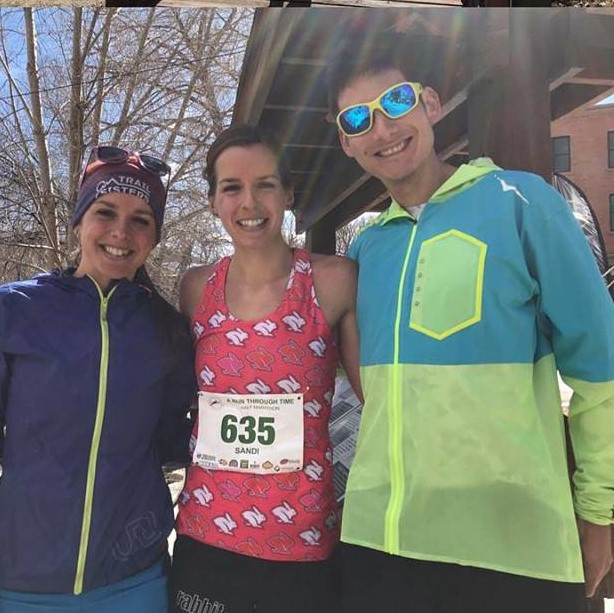
Me, Sandi, and her partner Sage after her win at the Run through Time Half Marathon in Salida.

Theodore Roosevelt, the 26th president of the United States, said: “Comparison is the thief of joy.” *

Those words have held true for my most of my life.

Here’s a look at my thought process and downward spiral:

“I must not be that slow if they thought I was Sandi.”

“And maybe I’m not that much heavier.”

“Or maybe they think Sandi got slow and gained weight.”

“Why can’t I be as fast and skinny as Sandi?  We have the same genes!”

And so it goes.  Ugly right?  Makes one feel kinda crappy.

Why does this make me and, probably you, feel crappy?  Well one, my guess (or at least my hope so I don’t feel totally alone in this habit) is that you’ve had similar thoughts.  Second, when we compare or judge, it is usually a reflection of ourselves.  It has to do with our own lack of self-worth, feelings of not being good enough.  (So please, give yourself some compassion here!  You mostly have a wound from a past trauma or situation that made you feel like this.  Comparison and judgement are often the ego’s idea of self-protection.  It’s of course a false form of protection, but it helps to know this so we can learn and change the habit.)

I can’t tell you how many times comparison has been a dark cloud in my life.  I’ve compared myself to my classmates in grad school ‘They’re so smart! How did I get in?”, relationships “He’s so intelligent, handsome, and skinnier than me.  Why is he with me?” (that lead me to unconsciously act like a jerk that lead to the breakup), and even to all of the pro-athletes in Boulder that work out for hours each day and have bodies of gods and goddesses.

The funny thing is, when I truly reflect on where I am in life right now, I’m happy with where I am and with who I am.  I’m about to enter my 3rd year of graduate school in Naropa’s Transpersonal Wilderness Therapy program and work for SAGE Running part-time.  I don’t have time or energy to work out for hours and have 6-pack abs.  Which is totally fine! I rather be working to become an awesome therapist! I also have a wonderful partner who loves me and will call me out when I start to become “Judgey, McJudgey” (his words, not mine). My body is still exhausted from the extreme exercise and dieting in my younger years, but now I can still run for a few hour in the mountains with my dog.  That is happiness for me.  Life is truly amazing!

salida 2018
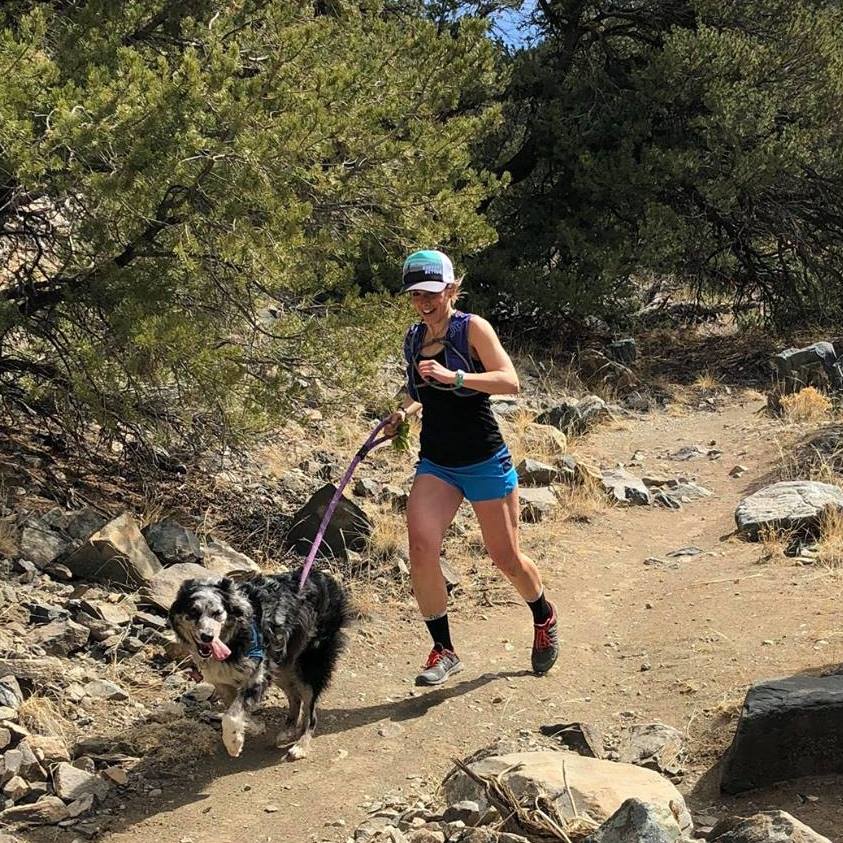
All smiles (and tongue) running with my best friend in Salida.

So recently, when I went on a 3-day solo as part of my Rites of Passage journey for my Transitions class (I know, I know- I did that for school! Again, totally awesome.) In addition to going into my 3-day solo with two intentions I wanted to honor for myself, I also considered the piece of me that I wanted to let go of.  I decided the piece of me that I wanted to let go of was my comparing self.  It may have served me in some ways over the years, tried to protect me, but I was ready to say “thank you, but I never want to see you again.”  I can’t say what went on during my 3 day solo, as I feel it is a bit too sacred to write in a blog, but what I can say is I focused on loving and honoring myself.  I found my beauty, deep within in me and in my body-including my curves and touching thighs.  Part of what I found was love for myself, which pushed out any need to compare myself to others.

Of course, that doesn’t mean that my comparing mind is gone for good.  It likes to sneak back in here and there.  But I’m on the lookout and ready to call it out when it rears it’s ugly head.  Like today, when I was beginning a run with my pup at Golden Gate Canyon State Park.  We were headed up a rocky trail that had a lot more vertical than I expected, and I was hiking.   There was an instant where I thought “I’m sure a lot of other runners could run up this.”  Then, the magic came.  I said to myself “Who cares?  Let’s just enjoy this time in nature with your best friend.  If you end up hiking a lot, then you just get to spend more time outside!  And I did hike a lot.  And I smiled a lot.  Which I actually think helped me save some energy to run at the end, in between my pup’s creek baths.  It was a beautiful, joyous morning.

0518180956
Pacer, distracted by another dog, while I try to take picture at Golden Gate Canyon State Park.

I’m sure there is someone our there thinking “But comparison is a motivator, it makes you want to get better.”  And maybe it does.  My issue with comparison in running is the “beat the other guy/woman” piece.  The ego steps in.  I’m not enlightened enough to say that comparison and ego are always bad, but at least from what I’ve witnessed, ego and comparison might help get you ahead for a bit, but it doesn’t last.  In looking at elite runners, the ones who continue to win are the ones who have an internal motivator, the ones who continue to find joy in what they do.  Looking at all runners, the ones who are often able to run for years are the ones who can do so with less comparison and with more focus on the process.  They have an inner drive, a gratitude for their own ability, and a sense of play whenever they get outside.

With that being said, I’m definitely not perfect.  But when those clouds of comparison begin block out my light, I’m learning to see the thoughts for what they are and bust my rays right through them.   Then I get back to playing with my dog.

With Joy,


Ray


*Okay, maybe comparison isn’t always bad: https://medium.com/thrive-global/roosevelt-was-wrong-comparison-is-not-the-thief-of-joy-9e490cd6225