Panic Attack: A Trapped Soul

I tremble.
I shake.
I scream.
I shatter.

Chest heaving.
Barely breathing.

I try to cling to the air
that always seems to escape my lungs
too soon. 

My mind races.
My heart leaps.

I press my hands to my center
to make sure that it is still there
beating inside
still keeping me alive

even if part of me wants to…

I continue to struggle.
I grasp at the oxygen barely trickling in. 

Inhale.
Exhale.

Rise.
Fall.

Crawl.

Slow.
Eyes closed.

Tears fall.
I wipe my cheeks and
the blurriness from my eyes.

I see a little clearer.
It was another nightmare, 
after all. 

*****

A panic attack is akin to the feeling of claustrophobia-
being trapped inside a coffin,
the soul suffocating inside the constraints, the cafe, of a fearful mind.
To the person experiencing a panic attack,
there is no way out. No escape.
The dirt piles on.
The only option is to surrender to exhaustion, or…
…to breathe so deeply into the center of your heart that the soul rises above the body, 
above the stories, above the pain. Back to truth.

****

While there is no single statistic, it is estimated that around 10-25% of people have experienced a panic attack in their life. I have. Many of my clients have.

So I write this to bring empathy. To bring understanding to the experience. Of feeling like you’re alive, but 6 feet under, with no chance of escape. 

And, while there IS an escape, or really, a path to freedom… it’s not a snap of the fingers, just be normal and get up kind of thing.

It’s gradual. It’s subtle. It’s a journey for the body that has experienced trauma, pain, and general unsafely to come back to a deeper knowing that, regardless what happens, all is well. To a foundation of love and security. A return to the soul.

Help and support can come in different ways.

If you’re a partner, a friend, or family member reading this, you can help someone regulate their nervous system simply taking your own deep breaths and not leaving their side (obviously, you get to have boundaries too!). 

A partner can hold their loved on, put a hand on their heart, and take slow deep breaths.

A friend can offer a hug, hold their friends hand, sit shoulder to shoulder, or simply be on the other end of the phone, not talking.

This is essentially mimicking what so many of us never had… a parent with their own, calm nervous system unconditionally loving us as infants, toddlers, kids, teens embracing us in our own big emotions. Not having this is the first trauma we experience.

Help take care of them while they rest. Cook for them. Clean their living space. Do the things that they could never ask for, because they don’t believe they deserve it. Personally speaking, I know I always needed that kind of rest that only love provides, but I was always fighting just to keep up with life. (Panic attacks are often linked with depression and/or anxiety. They are not contagious. They are not a disease. But yes, do treat your loved one with the same care as you would with a physical illness.)

If you’re alone… put a hand on your own heart. Do you’re best to let go of though (again- do your best, I know how hard it is) and slow down your breathing. You can also envision a loved one near you, and angel with their arms around your, or, my new favorite, the Divine Mother holding you…now, and as an infant, her simple touch reminding you of who you are. A spark of Light, a child of the Divine. 

I would also be remiss if I didn’t mention the healing power of animals and the simple soothing technique of slowly stroking their fur, or placing a hand on their heart center and breathing deeply, allowing their unconditional love to help you regulate. And of course, please seek professional guidance and allow someone to help you heal your wounds. 
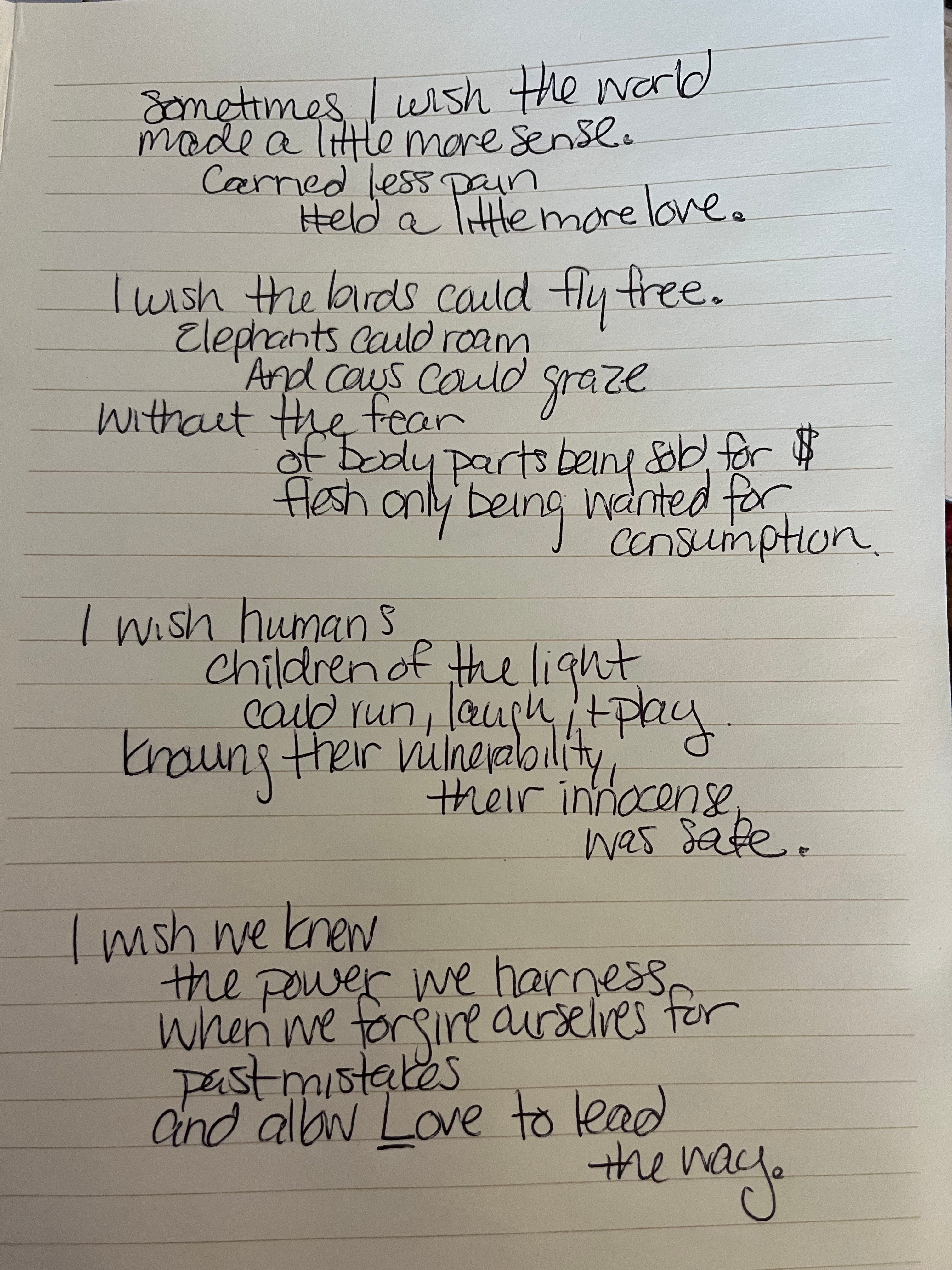
sometimes i wish

Sometimes i wish the world made a

little more sense.

Carried less pain.

Held a little more love.

I wish the birds could fly free.

Elephants could roam

and cows could graze

without fear

of body parts being sold for $.

flesh only being wanted for consumption.

I wish moms could drive their sons to school

without being shot.

And dads could protect their families by putting down their guns.

I wish humans

children of the light

could laugh, run, play

knowing their vulnerability, their innocence, was safe.

I wish we knew

the power we harness

when we forgive ourselves for

past mistakes

and allow Love to heal all.


Sometimes i wish the world made a little more sense…

I will forever shed a thousand tears and feel fully enraged driving past the slaughter farms of eastern Colorado and watching the cow-sentient beings Aushwitz trucks drive by.

And body will always feel the pain of another woman being slain in the name of love.

https://open.substack.com/pub/adogandhergirl/p/sometimes-i-wish-625?r=1ebnaa&utm_medium=ios&utm_source=post-publish

(I started writing this post before the tragedy In Minnesota- bot these pains, all the pains, feel true in my heart. Perhaps, as Martin Pretchl famously preached in his speech Grief and Praise, it is the job of empaths, the job of healers, namely woman identified people, to publicly grieve so we can all tend our hearts. Then push ourselves off the ground once again, and continue are march not with guns and hate, but with the power of broken hearts and love expanded.)

Subscribe now


Imperctet to Perfect

It is through our imperfections that we know our perfection. Our wholeness. Our truth.

Our soul, unchanging, is perfect.
As humans, we make mistakes.
We call ourselves imperfect, but really, making mistakes is just part of the game.

Regardless, it is in having compassion for ourselves when we make mistakes that we see our Truth.

It is in loving ourselves through our imperfections that we know our Wholeness.

It is in the contrast of knowing who we are not (we are not mistakes, we are not bad, we are not sinners) that we remember who we are.

Sensitivity: An Expansion

I like to define sensitivity as being highly attuned to both the external world and one’s internal world, which includes feeling one’s experience of it.

And really, we are all sensitive. Science shows us that our brains and bodies are constantly getting information from our environment, more stimuli than they were designed to handle, hence why training our attention is so important, or our brain will always default to the (often) perceived threat. If we have an unprocessed emotion like fear, the mind will create a negative belief by connecting past memories and weaving them together in a story-like structure, all designed to keep us safe- and it probably did, as a kid. As an adult, that negative belief is most likely our cage. 

Furthermore, we all have thousands of thoughts per day! (I’m not going to get into the scientific debate on exactly how many.) Most of us walk around completely unaware of our thoughts, which allows our subconscious to control our day without us knowing. This is while practices like mindfulness mediation and a parts work, which can help us explore and uproot negative beliefs, are so important. But back to the point of this post…

We are all sensitive beings. It’s part of being human. Some of us are just more sensitive than others, perhaps because of childhood trauma, which causes a child to become either hyper or hypoaroused (hypersensitivity helps a child be alert to their surroundings as a safety mechanism while hyposensitivity would help a child numb any sensitivity, a useful survival mechanism if they can not control what is happening to them or around them.)* Or, we may be genetically, or perhaps energetically, more sensitive. Oftentimes, it’s both: a combination of childhood experiences and a personal attribute. 

*We could also describe hyper as anxiety or ADHD and hypo as depression. It’s also common to see the two together, experiencing both anxiety and depression. If you’re tracking and know a bit about psychology, you’re probably realizing that this could appear as a bipolar diagnosis as well. I also had a professor in graduate school, Duey Freeman, describe anxiety as asking the question “Is it safe to be me?” and depression as “It’s not safe to be me.” So, another possible way of looking at this is the anxious feeling is actually the true self wanting to be released, with depression continually coming in as protection saying, “No, it’s not safe for you in this world.”

A highly sensitive individual is HIGHLY attuned to their external environment and internal world and feels it all, deeply. They are not only computing other people’s tone and facial reactions, their own and others (including animals) emotions, thoughts, past experiences, and the energy around them, but also ancestral lineage, stories and unhealed pains that have interwoven themselves throughout times*, messages from the spirit world, and a deep desire to heal. 

*Here, I’ll include Carl Jung’s idea of the Collective Unconscious and Eckhart Tolle’s description of the universal Pain Body. 

At least in part, I believe this makes the case that the problem is not emotions or sensitivity, but living in an emotionally unintelligent world that resists emotions (energy) rather than embracing them. Embracing emotions means we’re allowing more energy into our body, increasing our power (energy), and opens our hearts to not only our own pain but the suffering of others-humans and animals alike- as well.

Most highly sensitive individuals have to learn how to numb in some way because not only is all the information overwhelming to the human brain and at times painful, but because it is tragically undervalued and undernourished. 

If you are an adult reading this and resonating with this message, your work now is to:
– Nourish yourself: Embrace and nurture (offer compassion) to all the emotions that you had to suppress as a child to fit into your family, friend groups, church, or society at large. This includes loving your protector parts that you don’t like (like a perfectionist part or inner judge) because it most likely formed when it was not safe for you to shine and be your true, confident, sensitive self. Once your hidden gifts (sensitivities often come with deep intuition, connection to spirit guides, or healing powers) start to emerge, nurture them too as if you were nurturing an infant. We can only grow into our gifts, and who we are truly meant to be, through love. 
-Value your gifts: This will take some bravery at first. You will doubt yourself and ask “Who am I to do this/be this/offer this?” Remember, those voices are just protector parts that you can offer compassion and safety as you move forward. (Go slow. If you overdo it, the protector parts won’t feel safe and cling on stronger.) Keep practicing. Keep going. Find other highly sensitive individuals who are stepping into their gifts too, and cheer each other on. The best thing about living in 2025 is knowing there are others out there to connect with. Personally, I most appreciate working with my therapist (a fellow Naropa Alumni) as well as my Reiki coach/friend, and energetically connecting with my dog. I’ve also been part of Lee Harris’ Portal Community and follow many other healers and intuitives like Sarah Landon and Gabi Kovalenko. You belong. You were meant to be right here, right now. 

Revealing Potential

“What is it that gets in the way of us, human-spirits, living our highest potential?”*

Lack of love for ourselves, self-hate, thinking we are not enough, that we are broken- these beliefs are all childlike energies stuck in our psyche, manifested in the body, and buried beneath layers of neuro-wiring. These beliefs need nurtured back to love, so they can return to the light. It is through consistent nurturance and compassion, being shown and not just told they are safe, that these young energies can release the mental myths they clinged to and naturally be reformulated and reconceptualized into Truth. With Love as our base- then, we can be BRAVE.
We can venture out into the unknown- towards the destiny blocked by the egoic eye- to the potential that lies beyond the shadows.

As always, Love is the answer.

* I received the message recently that I was meant to share, and trust, more of my intuitive gifts, gifts that are still very much in the infancy stage due to undernourishment (after all, I did grow up in the Catholic Church where only men were allowed to preach) and often being passively shunned throughout my life (still, so many men don’t want to receive messages from women). With that, not everyone will get these messages, and that’s okay- they might not be for you. Those meant to read these messages will most likely be others who identify as seekers, highly sensitive people, empaths, wanderers, spiritual enthusiasts, people who don’t feel like they quite fit in, and those who love beyond ordinary measures.

(Psychology note: A classic example used in Attachment Theory is a child at a playground. A child that has a secure attachment (a child who feels loved unconditionally and knows a parent is there supporting them) will feel both more brave to venture out into the playground to explore and, yes, PLAY, but also to know his/her/their current limits and to wait to say, try the monkey bars, until they feel more ready to do so.)

When Your Teen Fucks Up, Love Them


When your high schooler fucks up, when they make a mistake- because they will. Because they are human. Because their brain is still 10 years from being fully developed and now they have an increase hormones flooding their brains and bodies (it’s really as if teenager were designed to make mistakes at this period in their lives) and their in this weird liminal space between childhood and adulthood and they occupy an even stranger place called high school for half their day- love them. If you can do that, they will know unconditional love. And you have created a more successful path for them than any class ever could. 

***

One of my cousins started her freshman year of high school this year. While I considered texting this advice to her parents, I’m decided it would be best not to give unsolicited advice. So I figured I’d write it out and share it with you all instead. 

This advice, when a teen makes a mistake- be it getting an F, getting drunk, denting the car, etc.- is really true for a kid at any age. Mistakes are a huge and IMPORTANT part of growing. Mistakes show us what to do and what not to do and help us align to our values as well as to our highest selves. And, as mentioned above, it’s like teens are designed to make mistakes. Which makes a lot of sense in this very transitory time in their lives, as they figure out what they enjoy and the person they want to develop into as an adult.

With so much grace and respect to parents, a lot of us were taught that discipline*, yelling, and shame were the best ways to help shape a kid. But here’s what actually happens when we get mad or tell a kid “I’m so disappointed in you” when they make a mistake:
We put their still developing brains into survival mode*, which floods their growing bodies with cortisol and other stress hormones, causing them to sink into depression or become passive and a people please so they stay on your “good side”***( freeze & fawn), become defensive and yell back (fight), or run away, either physically or finding escape in addictions or other activities that may appear good, but can be founded in perfectionism and obsession (flee). 

*I’m not saying there is no action to be taken, but I’ll write more on that later.

*We enter survival mode anytime we feel unsafe. This means any time we perceive loving being taken away, because the primal brain translates this into the potential of being ostracized from our tribe (or family). 

***You may initially enjoy a “people-pleaser” child, but what you’re really promoting is an adult that will get walked over by others and have no boundaries, that can lead to extremely unhealthy relationships.

We also know that when teens make mistakes they are either 1) genuine mistakes or 2) they are already in fear. Again, when we are in survival mode, it is nearly impossible to make the optimal choice. The functioning of our prefrontal cortex is reduced, our amygdala is turned on, and our brains and bodies are being pumped with stress hormones. What love, compassion, and curiosity does is help a teen regulate back into their parasympathetic nervous system, which means that when you return to the conversational piece, you’ll actually be able to have a conversation without an argument but with understanding. It allows the child to know they are loved UNCONDITIONALLY. That even when they are not perfect, they are still loved. When we know unconditional love, we live from a space of worthiness. We make good decisions and live a life aligned with our values. We’re healthy. We thrive. Of course we want that for our teens! So, when your child sneaks out at 1am with the keys to your new car and brings it back with a huge dent (which is less likely to happen if unconditional love has always been your parenting style- and please practice self-forgiveness if not, because truly, YOU DIDN’T KNOW ANY BETTER*), first (after taking a few deep breaths yourself), give them a hug. We know that in order to sneak out, they were probably trying to feel move love and connection with their friends, seeking it from the outside because it was under sourced on the inside. They’re probably terrified of you upsetting you and losing the more conditional love that they already get from you. Let them know they are loved. They are safe. 

Then, once you know they’re nervous system is regulated (look for deep breathing and a calm demeanor) truly get curious and ask about their behavior or the mistake they made. Reflect not only their words but how they are feeling. It’s probably not the time to share your own stories, but do empathize and try to understand. Finally, if there is a disciplinary action to be taken, have a conversation about it with them first and state your reasoning. You might be surprised… they might actually agree with you. 

Then love them more.

* “I’m disappointed in you” and “You should know better” are two of the most shaming statements we use on kids, and ourselves. The feeling of shame basically revolves around the belief that we are not worthy of love because we a broken, something is wrong with us, or simply bad. This translates into the belief that if we are imperfect- or human, we don’t deserve love. Again, we want to encourage self-reflection and growth in positive ways. And to nullify the idea that one should know better: kids learn through repetition. It’s actually completely ridiculous of an adult to say this to a small child. While a teen might have a better understanding of right from wrong, they are often motivated by their emotions and beliefs. If we’re frightened or anxious in anyway, our capacity to learn is greatly reduced. I also know if you ever used these statements with your child, they were probably used on you. And you practicing self-compassion with yourself is one of the best gifts you can give your child. Dr. Kristen Neff gives a great example of using self-compassion as a way to help your child grow in her TedTalk: 

Grasp

File Settings

Done

Title

Description

Thumbnail

Will be cropped to a 3:2 aspect ratioUpload

Draft


I try to grasp…

Everything is moving so fast.

I beg to Time to stop.

But He just smiles at me.

So time continues to slip

as if it were water through my fingertips.

The more I cling,

the more pain I bring.

I plead.

I bargain.

I deny what it in front of me.

I tell myself a lie,

trying to counteract the belief inside:

Things will never be this good again.

I falter.

I flail.

I fall.

Here at the bottom, the only thing left to do is cry.

In the seemingly cruel reality of paradox, I know this is my only opportunity to fly.

As I weep into the Earth,

She holds me.

Not forcing me to rise,

but knowing that in Love,

I will begin the climb.

The Tree next to me tells me it’s time to leg go.

They know this is my only path to peace,

to remembering what I already know.

Death is but a new adventure,

a place we will all go to together.

It’s really not unknown,

because only in myth have we ever been alone.

I fall back into the Infinite,

and begin my journey-our journey to the Sky.

Heart Warrior: Inside theFlames


My hardest battles have not been fought on a field or on the concrete blocks of life. 
My most hard-won battles have been the dark nights I lay in bed and endured the shrieks and cries of the demons taking residency in my mind. Their shameful shouts threatening my light…

The only way I find victory, or rather, transcendence, is by laying down my sword, putting all but my shield down. It’s not so much a battle as it is a refusal to take part. The demons continue to yell and shout, projecting their own fears onto me, repelled back by the Truth I still hold.

From the fierce love in my heart, I breathe a ring of fire around me. Around us. I watch the demons dance around the circle,​ on the other side of the flames, their shadows cast beyond the light. They can’t touch me here. Inside the flames, in the space of protection my heart created, I tend to the frightened and confused inner child within. Standing my ground, I take hold of her face with my pointer fingers gently pressed against her ears so she can’t hear the lies cast by the shadows. I look deep into her eyes, speaking without words, I let her know that she “is Good”. The only thing that matters ​is the love that bonds us. The only thing that matters is that we are together​. She is fiercely loved, and that is the only protection she ​will ever need. 

I look around and hear ​the demons now faint screams and watch as the ​shadows try to cling. I take a deep breath and ​exhale. The demons fade away on their own.

I am the Love Warrior.

You will never be alone.

In me, inside my flames, you will always be protected.

*********

I wrote this the morning after another battle, knowing the lies my mind were telling me and yet feeling all the intensity of my shadow self. Breathing my way to peace, while trying not to get caught in another round. This is the vision that came to me. And, with that, with these words, I have to pay homage to the other spiritual and Love Warriors that have influenced me, reminding me of this important archetype: Glennon Doyle (who wrote a book entitled “Love Warrior“. I tried to think of another title as not to mimic her work, but nothing better came to me) and Meggan Watterson (I was reading The Girl Who Baptized Herself at the time.)

Try this: validate your shame.

You don’t need to agree with the voice to validate the emotion.

The “Emotions Wheel” has “ashamed” in the category of sadness. If I sit and feel into it, it’s fear, sadness, and anger combined. Then, there’s usually emotions under that, as the inner shamer is different from the part being shamed.

Honestly, the story you’re living in, the story that you’re broken or not enough, is really hard. And the shamer is just doing what it knows how to do.

We always do our best with the skills we have. If you dig into it just a bit, you’ll most likely realize that your inner shamer sounds a lot like one of your parents, enhanced by some other mean voices you’ve heard on TV.

The experiences and voices of others that gave birth to your inner shamer are most likely not from super memorable situations. It could be a small thing that felt really big and confusing in your little body.

For example, when I was a little kid and I said something “bad”, I would get my mouth washed out with soap. This might sound extreme now, or you might think, “why didn’t your parents just have your brush your teeth or use mouthwash?”, but this was fairly common in the 90s. Now, I was a really good little kid… and I was a kid. I can’t remember what I would have said, it just couldn’t have been that bad. But even if I said a swear word or was mean to one of my sisters, it’s because I didn’t have the skills to regulate my own emotions and the only thing I could to to release some of the anger or frustration or despair in my body was to let it out verbally. Again, I didn’t have any other tools, and this is probably what I saw others do. My parents too, were of course doing the best they could with the parenting and emotional skills they had. Unfortunately, that didn’t prevent my little mind from making up a story that when I mess up or have big emotions, that I’m bad*. Something is wrong with me. Which brings in a huge energy of fear, as I then question if I’m lovable. The story I further create is that I’m only lovable if I’m perfect. And in this fear, I strive to be perfect, but because I’m acting out of fear instead of love, I inevitably make “mistakes” (miss the mark) over and over again (and also, because I’m human). Because the only skill I learned was how to shame myself for making a mistake, I keep doing it over and over and over again. Until I learn about, and start practicing, self-compassion and Love, which my dog has been trying to teach me for over a decade.

*While I used a personal example, this is really how all our little brains work. This is called “egocentric”.

What we can start with is forgiveness. Forgive your shame for being so hard on you. It’s been doing the best it could with what it knows. Forgive yourself for anytime you missed the mark, because you were doing the best you could with the emotions and energy you had stuck inside of you. (We only do “bad” things if we feel bad inside.) And, half the time what you did was probably just fine, you put that “not good enough” story on top of it.

From there, you can practice self-compassion. Find compassion for the perfectionist, the achiever, and other critical parts of you that have been doing the best they could. Allow the inner child, the one that has been shamed, to feel all of his/her/their fear, confusion, frustration, and grief. (This will take time and most likely multiple therapy or journaling sessions.)

Then Love. This is less of a practice than going within and finding the Love within you that’s been buried. It might be breathing into your heart charge, or drawing on your dog’s beingness for inspiration. Ultimately, Love is your most natural state.

Failure Wrapped in Love

A Path to Enlightenment


Failure may actually be one of the best and most efficient ways to get in alignment with the truest and highest versions of ourselves. A path to really living our best lives. …IF we can wrap failure in love.

The more mistakes we make, the more we learn how a choice or path isn’t for us, or we realize the way in which we are trying to get where want to be is out of whack (fear-based), and the more we have the opportunity to remember who we really are.

Which takes us to the blocks around failure. Shame (a topic I’ll talk more about how to work with soon) prevents us from evolving and seeing the failure, or simply the situation, with clarity. When we get lost in shame and stories of how we’re bad or not enough, we can be assured we’ve identified with our subconscious programming (small selves/ego) and NOT our Higher Selves. The irony is that the more we stay in shame (which believes we’ll make a better choice if we’re super mean to ourselves), the more likely we’ll take the take the wrong path again, make the same mistake, and fail again. (If the emotion is in you and still in the shadows, you probably won’t even know when you’re doing this.)

Yet, if we see failure through the lens of love, or rather, we love ourselves when we make a mistakes, we open ourselves up to new ideas, paths, and…to use a super spiritual word, EXPANSION. Loving energy helps us see new options and make more optimal choices (we’re past good or bad when we’re in this space).

Because we know we “We cannot solve our problems with the same thinking we used when we created them”, to quote Albert Einstein (a super spiritual dude and scientist), it’s not thinking about being kind to ourselves that’s going to get us out of this one. Which to me, is a relief, because my neural pathways are pretty set on how I really did screw things up. (Yes, I’m right here with you on this topic.) In addition to working with childhood memories on how our shame got its origins, what we can start doing is FEELING into the energy of compassion. Personally, I have no problem doing this with my sister, my dog, my dad, etc. Once I conjure up this feeling thinking of them, I can then PRACTICE (it is a practice) turning it towards myself. Try it our yourself.

I’ve got a lot more to say about shame coming up, when I have time to write more of my thoughts down. For now, here’s some food for thought and some compassion to feel into.